Showing posts with label disaster\. Show all posts

Wednesday, June 2, 2010

Central America Reels From Tropical Storm Agatha

GUATEMALA CITY: Central America reeled on Tuesday after the first eastern Pacific tropical storm of the season, Agatha, hammered the region with heavy rains that killed 179 people and washed away thousands of homes.

Hardest hit was Guatemala, with 152 people killed, dozens injured and at least 100 people missing following the floods and mudslides that swept away ramshackle homes along hills and destroyed bridges and roads, complicating rescue efforts.

President Alvaro Colom released a photograph of a sinkhole in the capital that swallowed up an entire three-story building.

In countries on the mountainous and mostly poor isthmus linking North and South America, the poorest people often build their humble homes near rivers so they have access to water, only to have their homes endangered in the rainy season by swollen rivers and mudslides.

Tropical Storm Agatha, which dumped heavy rain on the isthmus just ahead of Tuesday's first day of the Atlantic hurricane season, left as many as 22,000 dwellings destroyed in Guatemala and 155,000 people forced from their homes, about half of whom remained in shelters, officials said.
Seventeen people were killed in Honduras and 10 people died in El Salvador as a result of the storm, according to official figures.

With millions of dollars in damages and the impoverished population particularly hard hit, the United States pledged 112,500 dollars and sent a plane carrying relief supplies Tuesday; the European Union pledged 3.6 million dollars in humanitarian aid.
Giant sinkhole creates chilling sight
A US airplane carrying helicopters and supplies was due in Guatemala City from its base in Honduras with four choppers from which emergency aid can be delivered to the Guatemalan Air Force, at Colom's request.

Guatemala City's response was hampered by a separate emergency: the eruption of nearby Pacaya volcano whose ash forced the closure of the capital's Aurora international airport since last week, when two people were also killed and three went missing. That left thousands of travelers stranded.
But Guatemala City's international airport, closed since Thursday, was reopened on Tuesday to commercial and freight flights, said civil aviation spokeswoman Monica Monge.

The World Bank said it was finalizing with Guatemala an 85 million dollar loan to help it cope with the two disasters.

Saturday, May 22, 2010

8 Survive Plane Crash In South India, 158 Dead

MANGALORE, India: An Air India Express airliner crashed outside an airport in southern India on Saturday, killing 158 people when it burst into flames after overshooting a table-top runway and plunging into forest below.

There were eight survivors after the Boeing 737-800, which had come from Dubai with 166 people on board including crew, appeared to skid off the runway in rain at Mangalore airport in Karnataka state, Air India director Anup Srivastava said.

At least 146 bodies had been recovered, said M. Nambiar, a top official in the Civil Aviation ministry.

"We had no hope to survive, but we survived," Pradeep, a survivor who is an Indian technician working in Dubai, told local television.

"The plane broke into two and we jumped off the plane. As soon as the plane landed, within seconds this happened."

Local television showed a fireman carrying what seemed to be the remains of a child from the smoking wreckage. Charred bodies lay in the forested terrain.

All the passengers were Indian nationals, an Air India official in Dubai said. Many were likely Indian migrant workers in Dubai. The pilot was Serbian and said to be very experienced.

Air India Express is the budget arm of the loss-ridden state-run carrier Air India, which has been fending off growing competition from private airlines.

The flight's black box has been recovered, the United Arab Emirates state news agency WAM said. But Air India official Nambiar said the search for the flight data recorder was still going on.

The crash appeared to be an accident, Indian officials said. One TV report said the plane hit a radar pole on landing.

"There was no distress indication from the pilot. That means between the pilot and the airport communication there was no indication of any problem," V.P. Agarwal, director of Airports Authority of India, told local television.

Indian officials said the plane crashed around 6 a.m. . TV images showed it struck a forested area, and flames were blazing from the wreckage as rescue workers fought to bring the fire under control.

"While landing at the airport, the plane deviated and hit something," said Krishna, another survivor. "It caught fire and we fell out. We looked up and saw some opening and came out through that route."

BOOM INDUSTRY

It was India's first major crash in a decade, which has seen a boom in private carriers amid growing demand from India's middle class.

A series of near misses at major airports, including Delhi and Mumbai, have sparked debate about how India's creaking infrastructure was failing to keep pace with an economic boom.

Indian Law Minister Veerappa Moily told CNN-IBN TV that he had opened a new runway at Mangalore airport just 10 days ago. The ill-fated Air India airliner was two years old.

Boeing said in a statement it was sending a team to provide technical assistance to the crash investigation.

The last major crash in India was in July 2000 when an Alliance Air Boeing 737-200 crashed into a residential area during a second landing attempt in the eastern city of Patna, killing at least 50 people.

With growing competition from private carriers, the Indian government agreed to inject $1.1 billion into Air India if the ailing state-run carrier came up with the same amount in cost cuts and extra revenue.

The airline lost $875 million in the fiscal year ended March 2009.

Hundreds of Air India pilots went on strike in September 2009 to protest at management plans to cut pay incentives. The strike was called off when aviation minister Praful Patel said the grievances would be dealt with.

Wednesday, April 21, 2010

Iceland Volcano Cloud Brings European Air Chaos

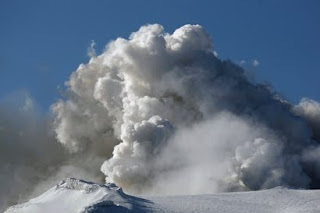
REYKJAVIK: A volcanic eruption in Iceland fired ash across northern Europe forcing the closure of huge swathes of international airspace on Thursday which grounded hundreds of flights.

The eruption of the Eyjafjallajokull volcano in southeast Iceland had already melted part of a surrounded glacier causing severe floods. More than 700 people were evacuated from their homes.

A huge cloud of ash from the second major eruption in Iceland in less than a month blew eastwards across the Atlantic, closing major airports more than 1,000 miles (1,700 kilometres) away.

Britain closed its airspace to all flights. Nearly every airport in Norway, Denmark and across northern Sweden also shut down, authorities announced. There was major disruption in Belgium, France, Finland, Germany and the Netherlands.

More than 300 flights out of London's Heathrow and Gatwick airports and others in Britain were cancelled, including transatlantic services.

British airport operator BAA said: "Following advice from the Met Office, the National Air Traffic Service has introduced restrictions to UK airspace this morning as a result of volcanic ash drifting across the United Kingdom from Iceland."

Many flights from the rest of Europe to North America would have to be rerouted because they normally go through British airspace, officials said.

The ash was about five-six miles (eight-10 kilometres) in the air and could not been seen from the ground. But experts said it was a danger to jet engines and restricted visibility.

Icelandic airports remained open as wind was blowing ash away from the island.

"Flights to and from Iceland are still ok. The wind is blowing the ash to the east," Hjordis Gudmundsdottir of the Icelandic Airport Authority told AFP.

"It's amazing really," she said. "Things here should be fine for the next 12 hours at least, and we think probably all day, judging from the weather forecast."

The volcano on the Eyjafjallajokull glacier in southern Iceland erupted just after midnight on Wednesday.

Smoke coming out of the top crater stacked more than 20,000 feet (6,000 metres) into the sky, meteorologists said. Icelandic public broadcaster RUV reported that a 500-metre fissure had appeared at the top of the crater on Wednesday.

Lava melted the glacier, causing major flooding which forced the evacuation of between 700 and 800 people. Evacuees were being directed to Red Cross centres.

"We have two heavy floods coming out from the melting of the Eyjafjallajokull glacier," police spokesman Roegnvaldur Olafsson told AFP from near the site of the eruption late Wednesday.

The eruption in a remote area about 125 kilometres (75 miles) east of Reykjavik was bigger than the blast at the nearby Fimmvorduhals volcano last month.

"It is very variable how long these eruptions last. Anywhere from a few days to over a year," Magnus Tumi Gudmundsson, a professor of geophysics and civil protection advisor in Iceland, told AFP.

"Judging from the intensity of this one, it could last a long time," he added.

Olafur Eggertsson said he had been forced to evacuate his farm, which lies in the path of one of two large floods of melt water coming from the glacier.

"At around 10:30 this morning we heard a lot of noise and saw mud and soil suddenly rushing down from the mountain. Just 30 minutes later we had mud and soil and a giant flood running into our dyke above the farm," Eggertsson told AFP.

"So in just a half hour, mud and soil came cascading down the mountain, down to our farm and on to the national highway that lies just beneath our farm. That is a total of four kilometres (2.5 miles) in just 30 minutes," he said.

His family left all their animals behind in the rush to escape.

"We have 200 animals on our farm: cows and sheep who are all inside now. It takes some time for the dykes to be destroyed and I don't know yet if they are in danger, but we are extremely worried," he said.

Last month, the first volcano eruption at the Eyjafjallajokull glacier since 1823 -- and Iceland's first since 2004 -- briefly forced 600 people from their homes in the same area.

That eruption at the Fimmvorduhals volcano, which gushed lava for weeks, ended Tuesday, experts said.